

1. What happens if there is no Constitutional Amendment on Delimitation
Why a fresh delimitation could happen
• No Constitutional amendment is actually required — Articles 81 & 82 already mandate it once the 2027 Census data is published.
Articles 81 and 82 of the Indian Constitution govern the structure and seat allocation of the Lok Sabha (House of the People).
Article 81 sets the maximum strength and the principles for distributing seats based on population, while
Article 82 mandates the periodic readjustment and delimitation of these constituencies after every census.
• Two automatic steps follow: (1) reallocating Lok Sabha seats among states, (2) redrawing constituencies within each state.
• BJP wants an amendment on top of this to raise the seat cap (up to 850), add women’s reservation, and use updated Census data — but it failed to pass in April 2026.
Timeline concern
• Last delimitation (triggered by 2001 Census) took ~6 years — commission set up in 2002, implemented in 2008.
• So this round may not be ready before the 2029 elections, possibly spilling into the next Lok Sabha’s term (this has happened before, under Vajpayee → Manmohan Singh).
The seat-value problem
• Seats have been frozen at 1971 population ratios since 1976 and 2001, specifically to avoid punishing states that controlled population growth.
• Result: an MP from Kerala now represents ~14 lakh voters, while one from UP/Bihar represents ~19 lakh — unequal vote value.
• Shifting to 2027 data would likely reduce southern states’ seat share and increase UP, Bihar, Rajasthan’s — reviving the federalism vs. “one vote, one value” debate.
Gerrymandering: Cracking vs. Packing
Even if every constituency has the exact same number of voters, how those voters are grouped can still swing results unfairly.
Cracking
• Splitting a party’s supporters thinly across many constituencies so they never form a majority anywhere.
• Example: Party A has 40% of all voters overall — but if spread too thin, it might win zero seats, leaving 40% of the electorate essentially unrepresented.
Packing
• Doing the opposite: cramming a party’s supporters into a few constituencies.
• That party wins those seats by huge margins, but “wastes” excess votes — while the other party wins more seats overall despite having fewer total supporters.
Bottom line
• Equal constituency size ≠ fair representation.
• Boundary-drawing decisions can be engineered to favor one party over another, even without changing vote totals — making the process of delimitation as politically sensitive as the numbers themselves.
2. Why Coimbatore is planting bamboo around its lakes
The project
• Bamboo fencing launched at two Coimbatore water bodies: 20-acre Kolarampathy (around Perur temple) and 90-acre Vellalore Lake (home to the city’s first butterfly park).
• Led by NGO Kovai Kulangal Padhukaapu Amaippu, with district administration support and CSR funding from JDFS Business Solutions LLP.
• Goal: stop encroachment and waste dumping, while reviving biodiversity — reviving a practice (lakeside bamboo/palmyra) that had largely disappeared.
What’s been planted
• Phase 1: 300+ bamboo saplings across 16 species (Burmese bamboo, giant bamboo, Taiwan giant bamboo, Travancore reed, Buddha belly, yellow bamboo, etc.).
• All 16 are “clumping” bamboos — short root systems that expand slowly in tight clusters, ideal for soil binding.
• Infrastructure: clearing invasive shrubs along a 1,000-ft bund stretch, a 1,150-ft GI diamond mesh fence, and drip irrigation for long-term survival.
Why Bamboo Works So Well
Soil & erosion control
• Roots form a dense, shallow, wide-spreading “mat” — effectively a living net holding riverbank soil together.
• Different species build different forest layers: giant bamboo forms canopy, Burmese bamboo forms mid-story, multiplex/bush/needle bamboo forms understory — creating habitat for birds, reptiles, frogs, and insects at every level.
Environmental benefits
Practical advantages
• Fastest-growing biomass — can grow up to 3 feet a day, harvestable in 3–5 years.
• Thrives across diverse environments; discourages encroachment/dumping simply by forming a natural barrier.
Beyond Conservation: Economic Potential
• Called “green gold” or “poor man’s timber” — a viable wood substitute.
• Usable across ~10 industries: architecture, furniture, lumbering, bioplastics, ethanol, bamboo fiber, etc.
• India has 168 species (106 native, 42 cultivated); Kerala Forest Research Institute houses Asia’s largest bambusetum (72 species, aiming for 80+) with 3+ lakh saplings ready for nationwide distribution.
• Historical roots: mentioned in Kautilya’s Arthashastra as an income source.
3. Sharks as “Mobile Ocean Sensors” for Hurricane Prediction
Why in News?
Researchers at the University of Delaware, USA are tagging sharks with small electronic CTD sensors to collect ocean data that can improve hurricane intensity forecasting.
- How does the technology work?
- CTD = Conductivity, Temperature, Depth
- Sensors attached to the shark’s dorsal fin measure:
- Conductivity → salinity
- Temperature
- Depth
- When the shark comes near the surface, the tag transmits data to satellites.
- Data can then be incorporated into oceanographic, atmospheric and climate models.
- Why are sharks useful?
- Sharks are widely distributed and highly mobile.
- They naturally move through different depths of the ocean.
- They can access areas where conventional observation systems may be difficult or expensive to deploy.
- Earlier animal-borne sensors were successfully used on elephant seals in remote polar regions.
- Species being considered/tagged:
- Shortfin mako, blue shark, smooth hammerhead and juvenile great white sharks.
4. Manas National Park: Key Facts
Location & background
• Situated in Assam, on India’s border with Bhutan, in the Himalayan foothills.
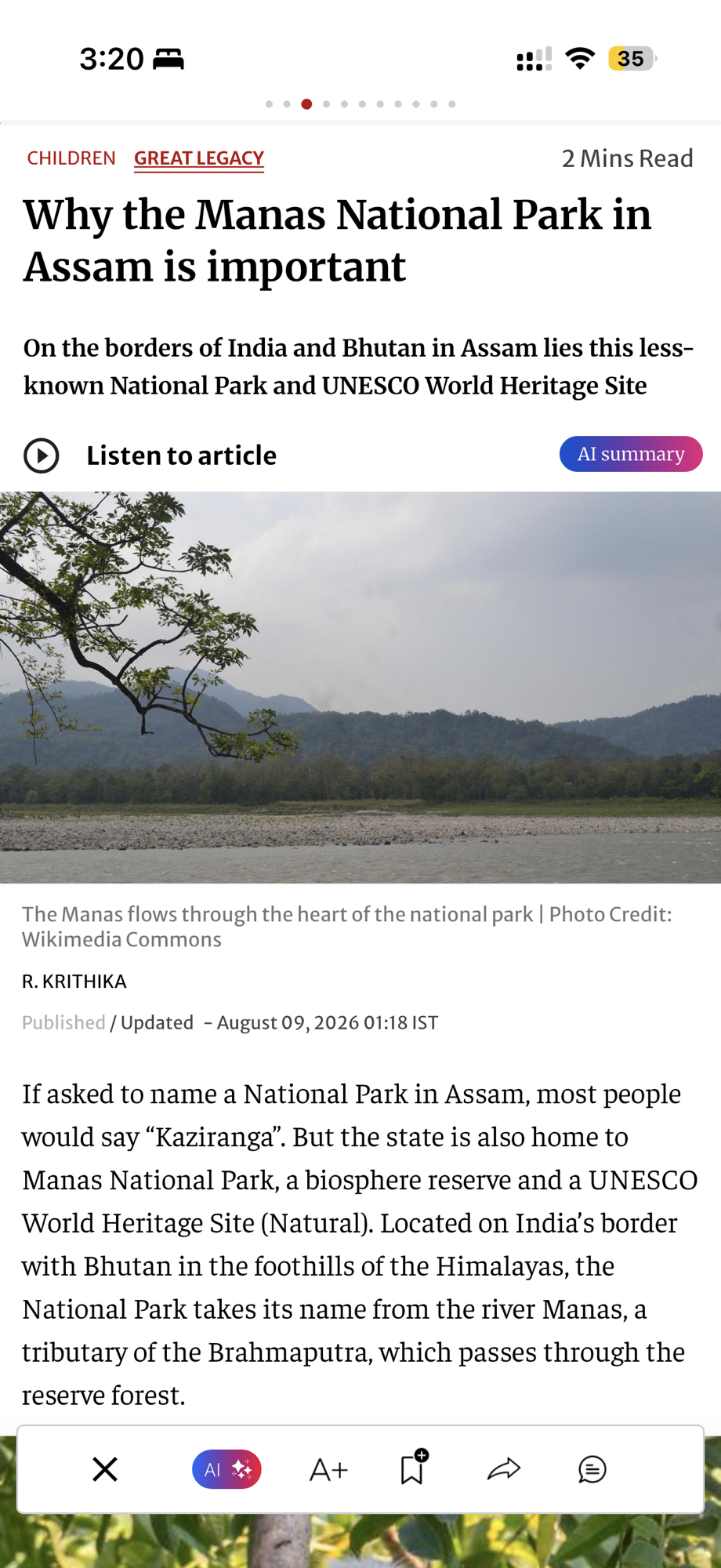
• Named after the Manas River, a tributary of the Brahmaputra flowing through the reserve.
• Originally a royal hunting ground (Cooch Behar and Gauripur families); declared a wildlife sanctuary in 1928 (391 sq.km), later expanded to 850 sq.km.
UNESCO status timeline
• Declared a UNESCO World Heritage Site (Natural) in 1985.
• Listed as “World Heritage Site in Danger” in 1992 due to heavy poaching.
• Removed from the danger list in 2011 after sustained conservation efforts.
• July 2026 (48th UNESCO session, South Korea): concerns raised again — over invasive species, encroachment, and the impact of Bhutan’s Mangdechhu hydroelectric project.
Biodiversity
Two biomes: grassland and forest, supporting:
• 55 mammal species
• 380 bird species
• 50 reptile species
• 3 amphibian species
Notable/endemic wildlife
• Rare/endemic species: Assam roofed turtle, hispid hare, golden langur, pygmy hog.
• Other key species: wild water buffalo, Bengal florican, slow loris, great hornbill, black giant squirrel, clouded leopard, fishing cat, crested serpent eagle, ospreys.
Did You Know?
• Manas is home to the world’s only known population of pygmy hogs — the smallest pig species on Earth.
• The Indian rhinoceros had vanished from the park due to poaching but was reintroduced in 2007.
• The Golden Langur was discovered here in the mid-20th century and exists only in Manas and neighboring parts of Bhutan.
5. Tamil Nadu’s First Mangrove Conservation Centre
Location & launch
• To be set up at Muzhukuthurai, near Killai, in Cuddalore district — Tamil Nadu’s first such centre.
• Groundbreaking ceremony held Wednesday by A. Periasamy, Chief Conservator of Forests, Villupuram Circle.
• Falls under the Tamil Nadu Shoreline Restoration Initiative (TN-SHORE).
Purpose
• Conservation and sustainable management of mangrove ecosystems.
• Focus areas: scientific research, biodiversity conservation, climate resilience, environmental education, and community participation.
6. APEDA Facilitates First-Ever Export of GI-tagged Mithila Makhana by Sea Route from Bihar to Australia
The initiative has enabled farmers to realise nearly 18 per cent higher returns than prevailing market rates.
APEDA, under the Ministry of Commerce & Industry, Government of India, facilitated the export in association with the Department of Agriculture, Government of Bihar.
Bihar accounts for nearly 85 per cent of India’s Makhana production.
7. AAERI Verify
• What: NeGD (MeitY) partnered with AAERI to launch ‘AAERI Verify’ — a digital platform integrated with DigiLocker for verifying documents of Indian students applying to Australian universities.
AAERI= Association of Australian Education Representatives in India
• Launched: August 7, 2026, at the AAERI Annual Convention, New Delhi.
• Purpose: Replaces manual paperwork with secure, consent-based, source-verified checks of academic, identity, and financial documents.
Two-stage process:
1. Student Check — before university application.
2. Sponsor Check — after admission offer, to verify financial authenticity.
Why it matters:
• Cuts fraud risk, ensures data privacy, and speeds up application processing.
• DigiLocker currently serves 72+ crore registered users; already used across UPSC, MEA.
Leave a Reply