

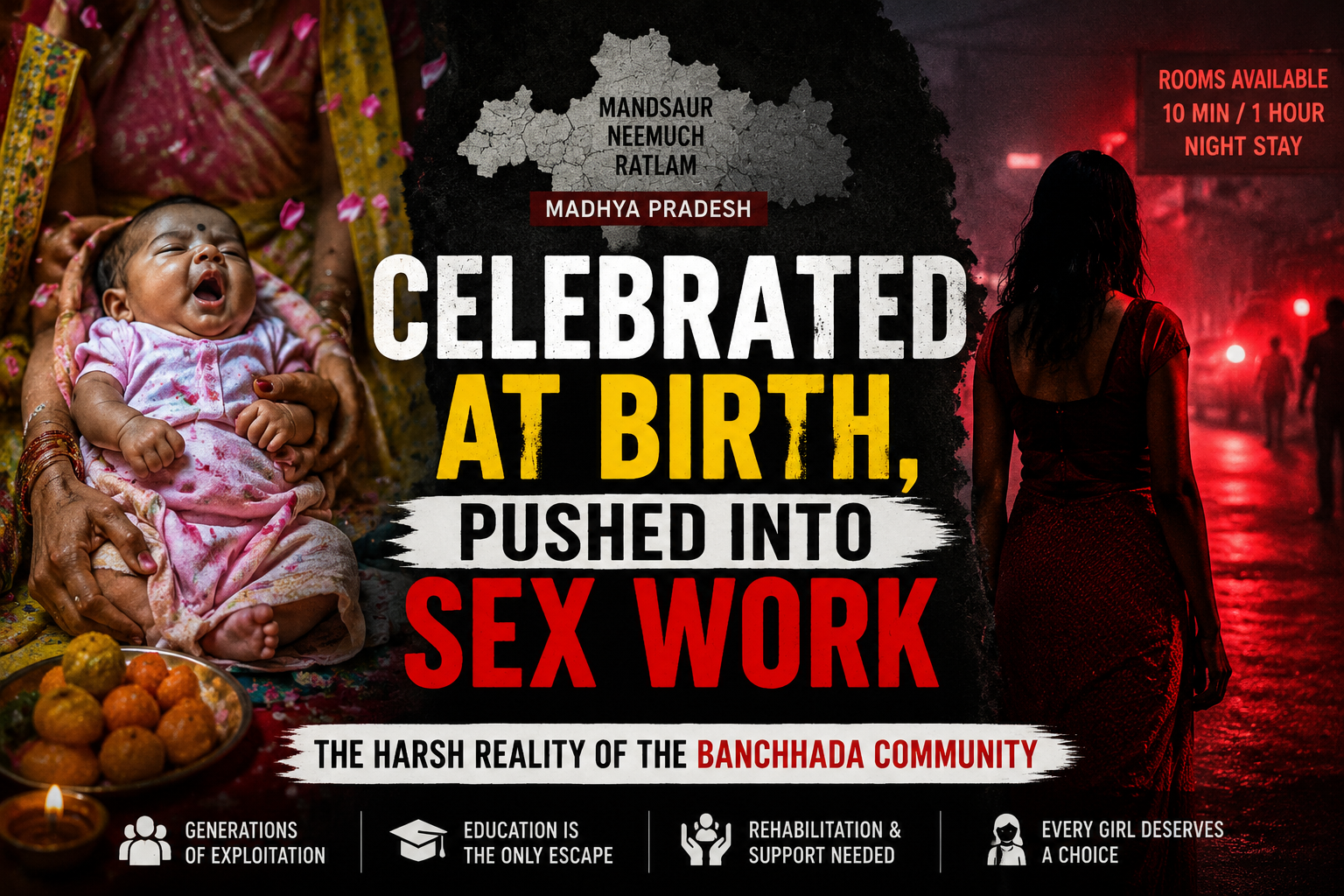
Banchhada Community: A Disturbing Social Reality in Madhya Pradesh

The Banchhada community, a de-notified tribe primarily residing in the districts of Mandsaur, Neemuch, and Ratlam in western Madhya Pradesh, has long been associated with a deeply rooted social practice where girls are expected to enter sex work after reaching puberty.
While the birth of a daughter is celebrated within the community, the celebration stems from the expectation that she will become the family’s primary source of income.
Why Does the Practice Continue?
Several factors have allowed this tradition to survive for generations:
- Extreme poverty and lack of alternative livelihoods.
- Social acceptance of intergenerational sex work.
- Girls dropping out of school after Class 8 or 9.
- Family pressure and emotional or physical coercion.
- Community elders protecting the practice in the name of tradition.
According to social workers, thousands of women and girls remain trapped in this exploitative system.
Historical Background
The origins of this practice date back to the British colonial era when the Banchhada community was notified as a “Criminal Tribe” under the Criminal Tribes Act, 1871. Community members believe that British police often demanded women in exchange for releasing arrested men, gradually institutionalising exploitation.
After independence, the community was de-notified in 1952 and classified as a Scheduled Caste. However, the practice continued due to economic dependence and social isolation.
Government Initiatives
The Madhya Pradesh government introduced the Jabali Scheme to support women from communities affected by caste-based prostitution through hostels and rehabilitation programmes. However, activists argue that funding has remained inadequate, limiting its effectiveness.
District administrations have also attempted to:
- Provide employment opportunities.
- Issue caste certificates through ancestral records.
- Improve access to education.
- Create livelihood options through skill development.
Despite these efforts, rehabilitation remains a major challenge.
Leave a Reply